Fort Sheridan Easement Rules Buyers Should Know
August 20, 2026
August 20, 2026
A 1.33-acre parcel on Patten Road has sat empty since a developer won approval in 1998 to build a nine-story condo tower there, the planned twin to a building completed next door around 2001. The site went up for sale in 2024, still zoned for multifamily use, asking $1.49 million. By May 2026, Crain's Chicago Business reported that Highland Park had rebuffed a different idea for the same land entirely: a proposal for 10 single-family houses that would have covered more ground than the original tower ever needed. Dennis Rodkin has covered both chapters for Crain's, and together they are the clearest evidence available of how Fort Sheridan actually functions as a real estate market.
That lot is not a curiosity. It points to something most buyers do not learn until they are deep into a transaction: in this community, you are not just buying a house. You are stepping into a set of agreements that were written decades ago and still govern what you can do with your own front door.
Fort Sheridan closed as an active Army base in 1993. When the federal government moved to decommission it, the two neighboring towns, Highland Park and Highwood, struck an agreement that shaped everything that followed. According to Crain's Chicago Business, they paid $5.75 million together for the fort's historic core, the 94-building district that includes the old parade ground, and passed the property at the same price to a joint venture called Town of Fort Sheridan Co. As a condition of the deal, no commercial development would be allowed on the former base. Development was capped at 551 residential units total.
That single restriction explains a lot about how the neighborhood feels today. There is no on-site retail strip, no grocery store, no restaurant row inside Fort Sheridan itself. The businesses residents use sit just outside the boundary in downtown Highwood. It also explains why that Patten Road parcel has been such a hard sell for so long. A typical mixed-use development can lean on ground-floor retail to help the numbers pencil. Fort Sheridan's covenant took that option off the table before the first shovel ever went into the ground, which is part of why only one of the two planned towers, known as the Ravines, was ever completed.
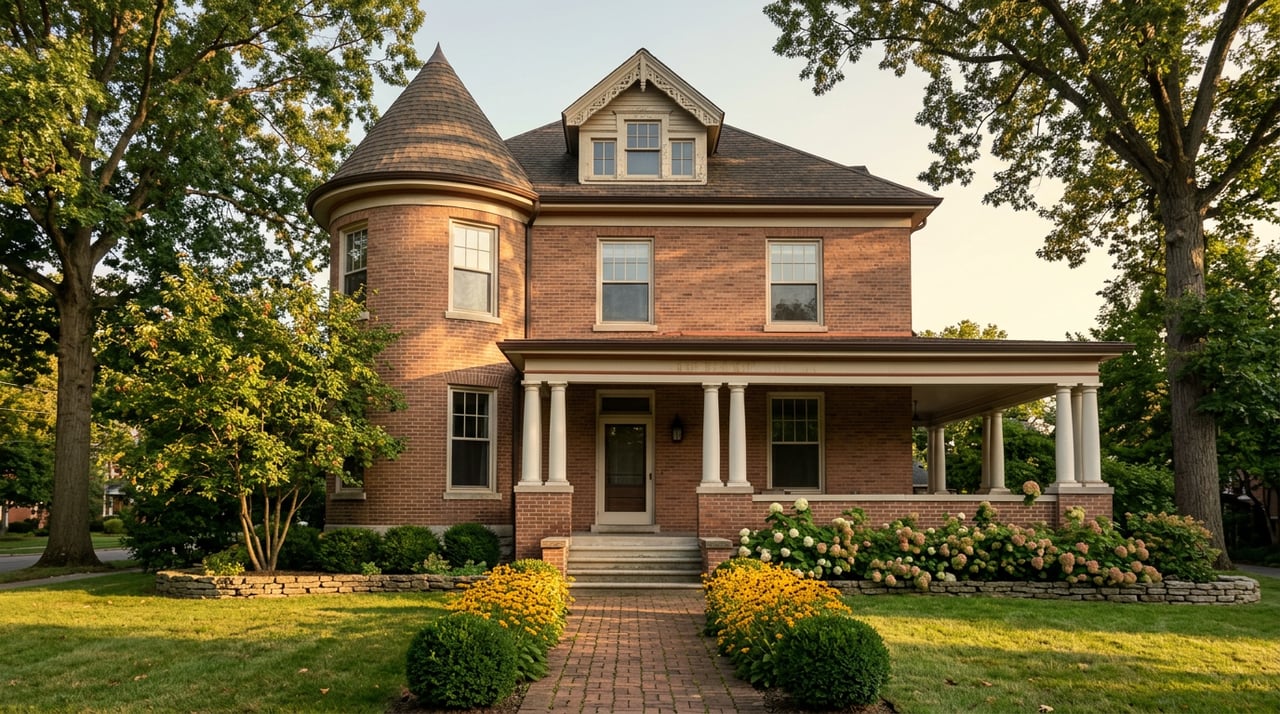
The single-family homes closest to the old parade ground carry their own layer of history. They were assigned by rank when the fort was active. Post Commanders got Queen Anne style residences on the bluff with corner towers and Romanesque Revival porch trim. Captains and lieutenants got brick, gable-front houses. Bachelor officers had their own quarters, now converted into condos.
Here is the part that surprises even buyers who did their homework on the history. According to Fort Sheridan's FAQ, every property in Fort Sheridan, whether it is a 1890s officer's residence or a townhome built in 2012, carries a Scenic, Open Space and Architectural Façade Easement held by Landmarks Illinois. It is recorded on the title itself, not tucked into an HOA handbook you might skim once and forget.
A preservation easement is an agreement. Landmarks Illinois conducts a review process through its Easement Committee, which meets monthly and requires a completed Request for Alterations Form before work begins on anything the easement covers. For the historic buildings specifically, Landmarks Illinois also runs annual inspections, and owners receive a letter afterward listing any maintenance items that need to be addressed by December 1 of that year.
There is one more detail that matters if you are on the selling side eventually rather than the buying side right now. Landmarks Illinois requires written notice before any sale, specifically so the easement terms can be explained to a prospective buyer before they close. In practice, that means the easement is supposed to surface during a transaction. Whether it actually gets flagged clearly, and early enough for a buyer to plan around it, depends heavily on how carefully the deal is handled.
Monthly HOA assessments across Fort Sheridan span a wide range, from well under $100 to well over $1,000, depending on the building. That spread is not random. It tracks almost exactly with the layer of history and amenity load a given building carries.
The mid-rise elevator condo building with its own pool sits at the top of that range, since its assessment covers elevator maintenance, pool upkeep, and shared building systems on top of the master association dues everyone pays. A historic single-family officer's home on the parade ground sits in the middle, since there is no shared building to maintain but there is still the master association's grounds and common-area cost. A newer single-family home or townhome built after the base redevelopment tends to land at the low end, since it carries the fewest shared systems.
Average annual property tax bills follow a similarly wide pattern, with recent inventory snapshots showing figures anywhere from the high teens into the low twenty-thousands depending on the size and vintage of the home. A buyer comparing two listings side by side without accounting for building type is comparing numbers that were never meant to be compared directly.
A few steps make the difference between a smooth close in Fort Sheridan and a surprise six weeks in:
That empty lot near the forest preserve is a useful way to close the loop. Demand for suburban condos cooled through much of the 2010s as empty nesters gravitated toward the city instead, and slowed further as downtown living lost some of its appeal in the 2020s. Someone apparently thought the moment was right to try again, just not with a condo tower. Highland Park's rejection of the 10-house plan in May 2026 shows the same friction that has defined this parcel since 1998 is still very much active today. Any future buyer of that land inherits the same no-commercial-use restriction and the same 551-unit ceiling that have shaped every other property in the community.
That is really the whole point. Fort Sheridan's character, the historic architecture, the open bluff, the absence of strip retail, comes from the same paperwork that will govern your renovation plans if you buy here. Buyers who understand that going in tend to have smoother closings and fewer surprises during their first design review. Buyers who skip past it tend to find out the hard way, usually around the time they want to change a window.
If you are weighing a purchase in Fort Sheridan or comparing it against other North Shore communities, our team at The GGL Group has spent years working through exactly this kind of layered approval process with buyers and sellers across Lake Forest, Lake Bluff, and the surrounding North Shore. You can also browse our Fort Sheridan neighborhood guide for a broader look at the area. When you are ready to talk specifics, schedule a call and we will walk through what a particular property's history actually means for your plans.
Does the easement apply to homes built after the base closed, or only the historic buildings? It applies to every property in the community, according to the Master Homeowner Association's own FAQ page, though the specific protected elements can differ between a 19th-century officer's residence and a home built during the 2000s redevelopment.
Do I need Landmarks Illinois approval for interior renovations? Preservation easements generally protect exterior elevations. Confirming the requirements on a specific property is worth doing before you budget a project.
Is the Patten Road site likely to become a condo tower again soon? The condo tower approved in 1998 is no longer the only idea on the table. As of May 2026, Highland Park had rejected a competing proposal for 10 single-family houses on the site, so the land remains undeveloped and its future use is still unresolved.
This article is general information, not legal, tax or financial advice. Consult a qualified professional about your situation.