Reading the Highland Park Median: What Your Money Actually Buys East of Green Bay
August 6, 2026
August 6, 2026
Open three real estate portals for Highland Park this week and you will see three different numbers. Zillow's Home Value Index sits around $735,000, up 6.5% year over year with pendings inside nine days. Movoto pegs the July 2026 median list at $897,000, or $333 per square foot, moving in about seventeen days. Altos, which tracks the active list side, has the median at $1,095,000 with a Market Action Index of 55 and only 39 homes on the board.
Those numbers are not contradictory. They are the same market photographed from three angles. What none of them show is the reason a 3,400-square-foot house four blocks from Rosewood Beach can trade for more than double an identical floor plan a mile inland. That reason is topography, and it is written into the zoning code.
Highland Park stretches nearly five miles along Lake Michigan and reaches inland past the Metra tracks and Route 41. Any single median rolls together lakefront estates, ravine-side mid-centuries, walkable downtown condos, and inland ranches built for a different era. Redfin's July 2026 snapshot of 33 new listings landed at an $825,000 median with about 40 days on market and an average of four offers per home. The offer count says the market is competitive. The 40-day figure says buyers are still picking their spot carefully. Both are true because Highland Park is not one market.
The practical read for a move-up buyer: the portal median is a starting point for tax planning, not for setting expectations on a specific street.
The clearest fault line runs along Green Bay Road and the Union Pacific North Metra line. East of that corridor, you are inside the historic grid, closer to the lake, and often on or near a ravine. West of it, lots get larger and flatter, subdivisions get younger, and the price per foot drops.
The ranges reported by market observers in the past year sketch the pattern:
| Sub-market | Typical range | What defines it |
|---|---|---|
| Deere Park / lakefront | $2M and up | Bluff frontage, large wooded lots |
| East Highland Park (east of Green Bay) | $800K–$2.5M | Ravine lots, walk to Rosewood Beach and downtown |
| Braeside | $1.2M–$3M | Larger estates near the Ravinia Festival grounds |
| Ravinia | $700K–$2M | Village-scale streets, Ravinia Metra station |
| Inland neighborhoods (Sherwood Forest, west of Route 41) | $600K–$1.2M | Larger flat lots, mid-century and later stock |
| Downtown condos and townhomes | $500K–$1.5M+ | Walk to Renaissance Place, new construction like The Wolbright |
A buyer working from the $897K citywide median who tours East Highland Park will feel priced out. A buyer with the same budget touring west of Route 41 will feel over-qualified. Both are looking at the same city.
Here is the mechanism that most out-of-market buyers miss until they are under contract.
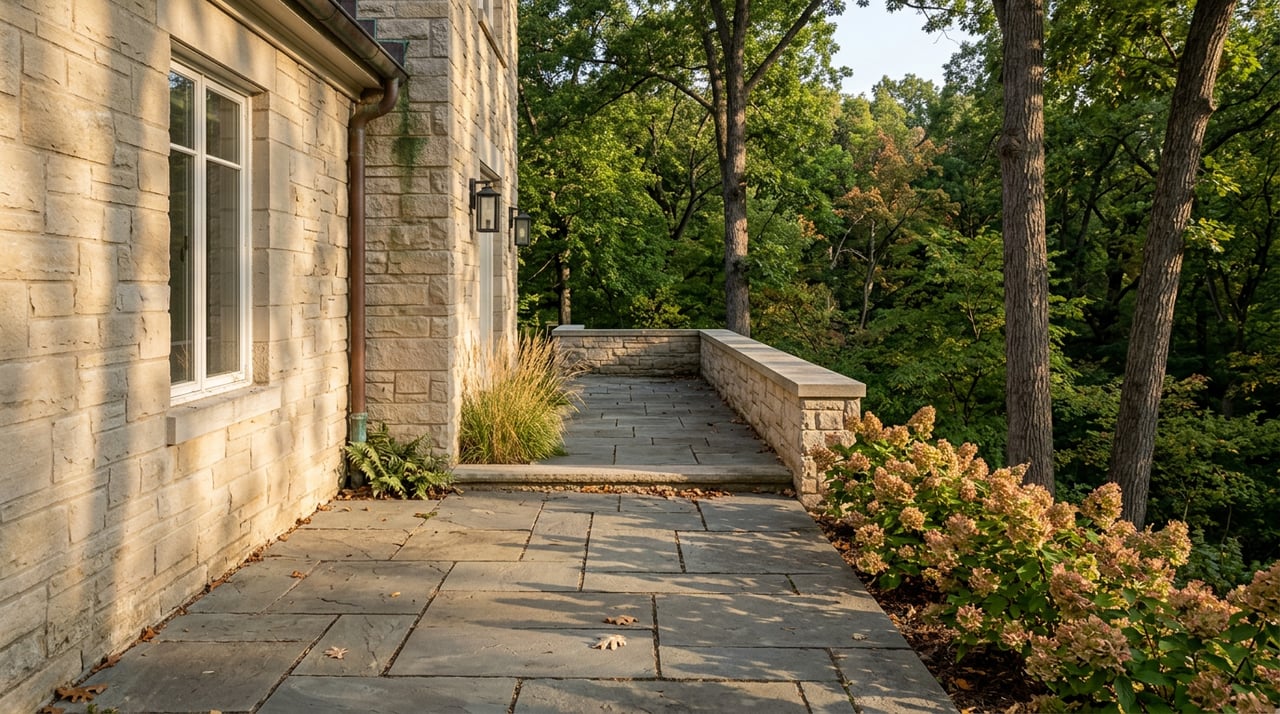
Highland Park's zoning code defines a Steep Slope Zone covering any property with a ravine or bluff, and it requires additional setbacks beyond the standard district requirements. Any new building, addition, garage, patio, or pool larger than 250 square feet, and any earth-moving over 50 square feet, triggers a drainage and grading plan and a City permit. Properties with 50% or more impervious area, or more than 16,000 square feet of new impervious surface, must provide stormwater detention under Article XVIII. Ravine and bluff parcels also route through Lake County's Watershed Development Ordinance, and lots without a nearby public storm sewer may be required to extend one at the owner's expense, with a recapture agreement available under Chapter 51 of the City Code.
In plain English: the same acre of land buys a very different renovation depending on which side of the corridor it sits on. A pool, a garage addition, or a rear terrace on an East Highland Park ravine lot can require engineering review, County permitting, and stormwater work that a comparable inland lot would not. Local contractors have been quoting garage additions in Highland Park in the $45,000 to $115,000 range, with historic district or slope review adding weeks to the timeline. Permits move through the Building Division at 1150 Half Day Road, and homes in the Linden Park Place, Vine/Linden/Maple, or Belle Avenue historic districts pick up an additional Certificate of Appropriateness step in front of the Historic Preservation Commission.
The ravine premium is real, but so is the ravine tax. Buyers pay more up front for the setting, then continue paying for it every time they want to change the footprint.
For a relocating executive comparing Highland Park against Lake Forest or Lake Bluff, this is the fact that changes the spreadsheet. It is not that eastern lots are worse investments. It is that the carry cost of owning and improving them is higher, and the negotiated price should reflect the work that will not be permitted casually.
The other pressure point on the map is the central business district. In late July 2026, Dallas-based Tabani Group listed Renaissance Place at 1849 Green Bay Road for a target above $40 million, engaging Newmark to market the 174,000-square-foot mixed-use complex. It was 87% leased at the time of listing, with anchor tenants including Compass, Starbucks, and DiNucci's, and a weighted average lease term of 5.6 years.
For residential buyers, the interesting detail is not the price tag. It is that the City has spent the last five years widening the residential envelope around this block. The Central District Residential Overlay approved by City Council permits entirely residential development along an eight-acre band on the south side of Elm Place between Sheridan and Green Bay, and the ground-floor commercial-only requirement was removed. New-construction condo product like The Wolbright is coming online in that window. A move-up buyer choosing between a downtown condo and a single-family home in Ravinia or East Highland Park is now choosing between two products that will both continue to grow in supply, but on very different curves. Detached lots east of Green Bay are finite. Downtown units are not.
A few adjustments to make when the citywide median is the only number in your head:
The 87% leased figure at Renaissance Place, the 39 active listings on Altos, and the nine-day pending window on Zillow all tell the same story from different sides: this is a well-occupied, well-tenanted market with thin inventory. Winning in it means knowing which median you are actually shopping against.
Is the ravine setback really that restrictive? It varies by lot, but yes, the Steep Slope Zone adds setback distance to the standard district requirement and can meaningfully shrink the buildable envelope on a small lot. On larger parcels the effect is mostly a permitting timeline issue, not a footprint issue.
Does the Watershed Development Ordinance apply to interior renovations? No. It is triggered by grading, floodplain work, wetlands, or impervious-area thresholds. A kitchen remodel does not touch it. A pool, a rear addition with a new terrace, or a driveway expansion often does.
How should I think about downtown condos versus a single-family west of Route 41 at a similar price? They solve different problems. The downtown unit trades yard and storage for walkability to the Metra, Ravinia shuttle, and Renaissance Place. The inland single-family trades walkability for lot size and a lower price per foot. Neither is objectively better; the right answer depends on how you use a Saturday.
If you are weighing a move into Highland Park and want the citywide median translated into the street you are actually looking at, the team at The GGL Group has been reading this market across five generations. Schedule A Call and we will walk you through the sub-market, the ravine review, and what your budget genuinely buys on either side of Green Bay.